warning: There is no guarantee of future profits, platform success, or token value appreciation.

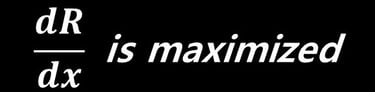
Variable Definitions
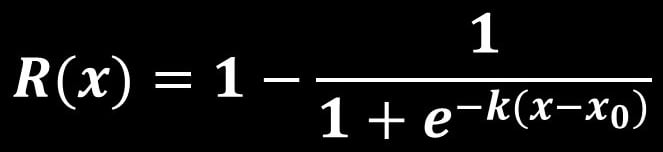
R(x): Normalized staking reward
x: Token value (market-based or index-based)
k: Sensitivity coefficient controlling adjustment speed
x₀: Inflection point where reward reduction accelerates
Reward Dynamics by Phase
Early Phase (x < x₀)
Token value remains relatively low
Rewards stay high with slow change
Strong incentives for early adopters and validators
R(x)≈1
Growth Phase (x ≈ x₀)
Token value enters rapid growth
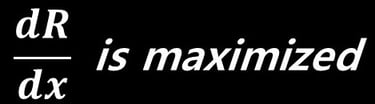
Rewards decrease at the fastest rate
Emission discipline is introduced gradually
Staking Reward Models
KRONA implements a dual-control staking reward framework designed to maximize early network participation while ensuring long-term economic sustainability.
The model combines time-based exponential decay with value-based inverted logistic adjustment, creating a predictable and disciplined emission structure.
1.Exponential Decay Staking Reward Model
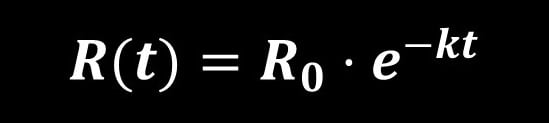
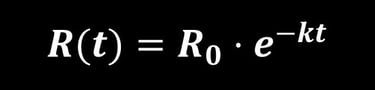
KRONA staking rewards follow an exponential decay model to provide strong incentives during the early phase of the network while preventing long-term inflation.
Reward Function
Variable Definitions
R(t): Staking reward at time t
R₀: Initial staking reward at t = 0
k: Decay rate (reward reduction coefficient)
t: Time elapsed (measured in months)
Model Rationale
Early Incentive Alignment
High initial rewards encourage early participation by validators and stakers, accelerating network security and liquidity formation.
Controlled Token Emission
Rewards decline gradually over time, reducing inflationary pressure on total token supply.
Long-Term Sustainability
The decay mechanism ensures that staking rewards remain economically viable without excessive dilution.
Infrastructure-Oriented Design
This approach aligns KRONA with infrastructure-backed blockchain economics rather than speculative emission models.
Investor Perspective
From an investor standpoint, the exponential decay model provides:
Predictable reward reduction
Strong supply discipline
Improved long-term token value stability
This structure positions KRONA as a cash-flow-oriented utility token rather than a purely speculative asset.
2. Inverted Logistic Reward Model (Value-Based)
The inverted logistic reward model adjusts staking rewards dynamically based on token value rather than time alone.
As token value increases, staking rewards decrease smoothly and asymptotically, ensuring long-term economic stability without abrupt emission changes.
Reward Function

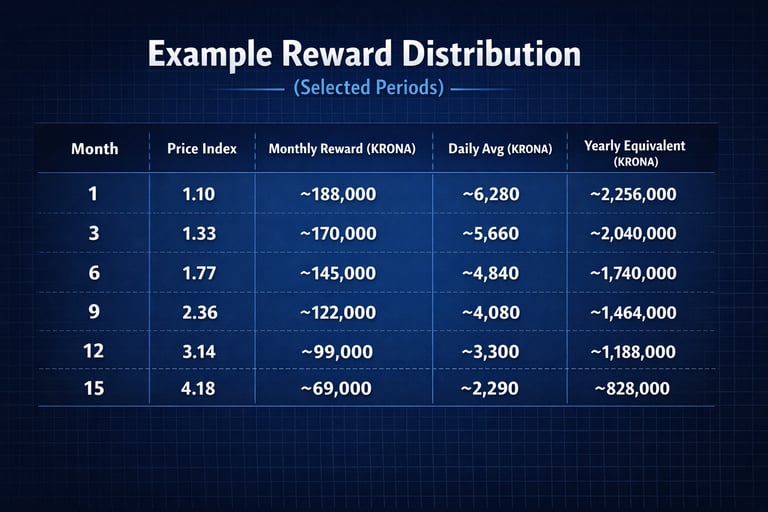
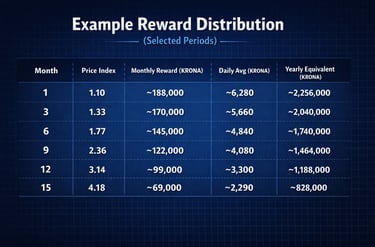
Example Reward Distribution (Selected Periods)
4. Single Staker Illustration (1% Participation)
Assuming a participant controls 1% of total staked tokens:
Month 1
Monthly reward: ~1,880 KRONA
Daily average: ~63 KRONA
Month 12
Monthly reward: ~990 KRONA
Daily average: ~33 KRONA
Month 18+
Monthly rewards decline sharply
Network transitions toward a low-inflation, maturity phase
Maturity Phase (x > x₀)
Token value stabilizes at higher levels
Rewards approach a lower bound asymptotically
Long-term inflation is effectively controlled
R(x)→0
Economic Rationale
Predictable Emission Control
The inverted logistic function avoids sudden reward shocks by enforcing smooth, continuous adjustment.
Value-Aligned Incentives
Staking rewards are tied to ecosystem growth and token value rather than time alone.
Inflation Resistance
As the ecosystem matures, reward emissions naturally decline, minimizing long-term dilution risk.
3. Staking Reward Distribution Example (Projection)
Simulation Assumptions
Monthly token supply: 200,000 KRONA
Distribution period: 50 months
Total distributed supply: 10,000,000 KRONA
Token price growth: +10% per month (compound)
Reward model:
Time-based exponential decay
Value-based inverted logistic adjustment
Monthly Reward Formula
Monthly Staking Reward=Monthly Supply×R(t)×R(x)
KRONA
Harbourfront, 2/F, 22 Tak Fung Street, Hunghom, Kowloon, Hong Kong.
Email: info@krona.cloud
© 2025 Krona. All rights reserved.
Contact Us
We are a leading global provider of cloud services, dedicated to making cryptocurrency mining accessible to everyone.