warning: There is no guarantee of future profits, platform success, or token value appreciation.

Characteristics and Advantages of RWA Business in Cambodia
Real World Asset (RWA) businesses in Cambodia refer to models that connect physical assets such as land, agriculture, infrastructure, commodities, and real estate with blockchain or tokenized financial structures. Among Southeast Asian countries, Cambodia has structural conditions that are particularly favorable for RWA development. Below is a detailed explanation of the key characteristics and advantages of RWA projects in Cambodia.
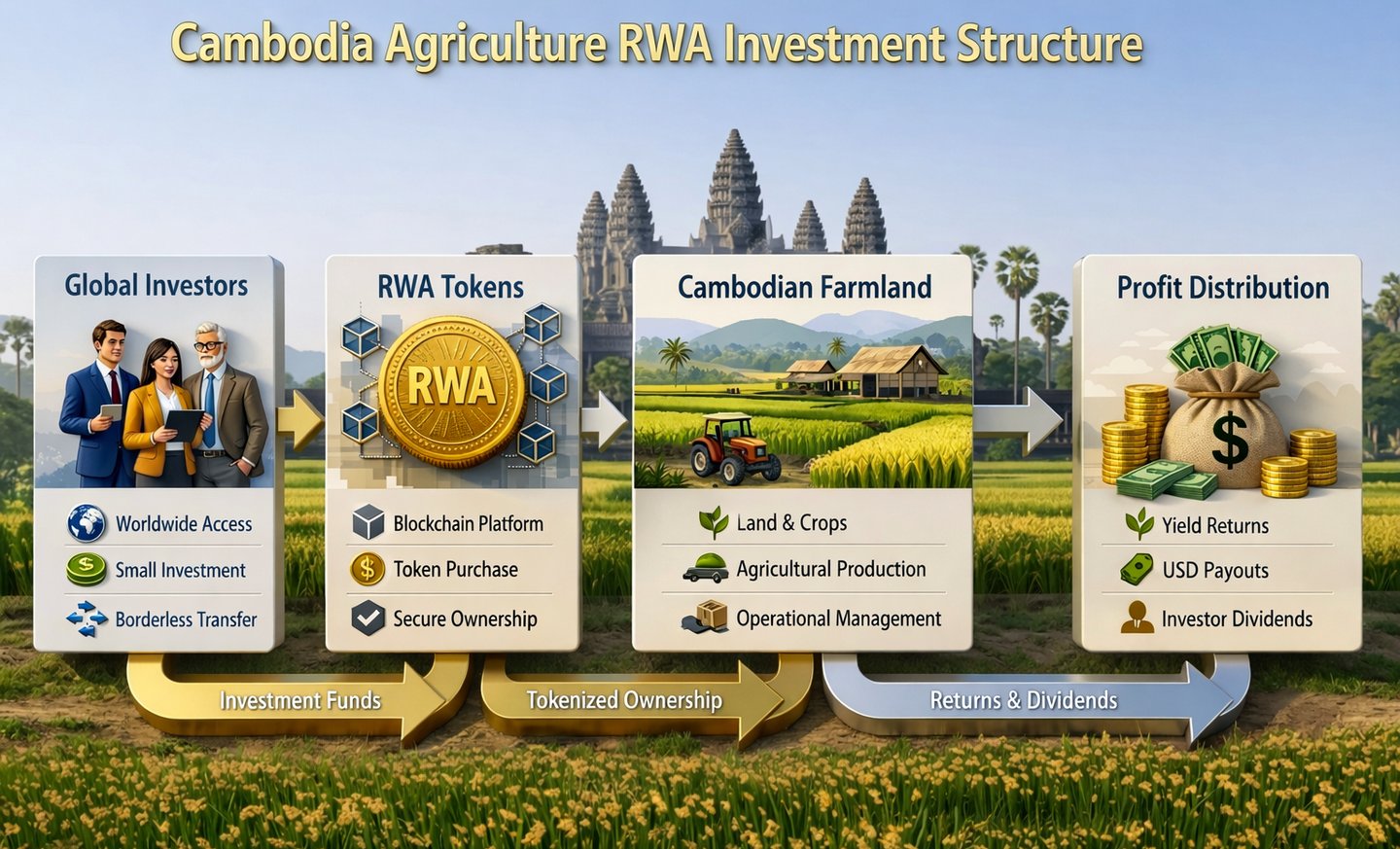
1. Structural Characteristics of RWA Businesses in Cambodia
1) Real Asset–Driven Economic Structure
Cambodia’s economy still relies heavily on real sectors rather than digital financial industries.
Major industries include:
Agriculture (rice, cassava, rubber, pepper)
Raw materials and commodities
Land development
Tourism infrastructure
As a result, the country offers a large pool of assets suitable for RWA tokenization.
Typical RWA assets include:
Agricultural land
Rice production rights
Rubber plantations
Solar power plants
Tourism resorts
Logistics warehouses
Commodity supply contracts
These assets are suitable for cash-flow–based tokenization models.
2) Large-Scale Agricultural Land Availability
Cambodia is one of the few countries in Southeast Asia where large-scale agricultural land acquisition is still feasible.
Key characteristics:
Low land prices
Potential for large-scale agricultural development
Foreign investment participation possible
3) Dollar-Based Economy
Cambodia operates largely as a USD-based economy.
Currency structure:
Over 80% of transactions are conducted in USD
Local currency (Riel) used in parallel
Advantages:
Lower foreign exchange risk
Easier participation for international investors
Stable global settlement environment
For RWA projects, this allows revenue distribution models denominated in USD.
4) Relatively Flexible Regulatory Environment
Cambodia currently maintains a relatively flexible regulatory approach toward blockchain and digital assets.
Key regulatory bodies include:
Securities and Exchange Regulator of Cambodia
National Bank of Cambodia
Key characteristics:
Blockchain experimentation is permitted
Digital asset research is ongoing
Tokenized asset structures are being explored
Additionally, the government actively promotes foreign direct investment.
5) High-Growth Emerging Market
Cambodia is one of the fastest-growing economies in Southeast Asia.
Economic indicators:
Average GDP growth: 6–7%
Rapid urban development
Increasing infrastructure investment
Key sectors with strong RWA potential include:
Tourism
Logistics
Agriculture
Renewable energy
2. Key Advantages of RWA Businesses in Cambodia
1) Low-Cost Assets Leading to High Token Returns
Example agricultural project:
Investment:
Acquisition of 1,000 hectares of farmland
Total investment: $5 million
Annual revenue:
Agricultural sales: $2 million
Net profit: $800,000
Estimated ROI: 16% – 20%
These returns can be distributed to token investors through blockchain-based revenue sharing models.
2) Global Investor Accessibility
RWA tokenization allows international investors to participate easily.
Investment flow:
Global Investors
↓
Purchase RWA Tokens
↓
Investment into Cambodian Agriculture / Real Estate
↓
Revenue Distribution to Token Holders
Advantages:
Small-scale investment possible
Borderless participation
Improved liquidity compared to traditional assets
3) Financial Infrastructure Gap Creates Opportunity
Cambodia still faces limitations in financial infrastructure.
Challenges include:
Low banking accessibility
Limited agricultural financing
Weak credit systems
Because of this, blockchain-based financial models can provide real practical solutions.
Examples:
Agricultural RWA financing
Microfinance platforms
Supply-chain financing systems
4) Government Support for Foreign Investment
Cambodia maintains strong pro-investment policies.
Foreign investment advantages include:
Easy company formation
Tax incentives
Special Economic Zones (SEZs)
Key government body:
Council for the Development of Cambodia
This institution supports:
Large-scale investment approvals
Land development projects
Infrastructure cooperation
5) Strategic Gateway to Southeast Asian Markets
Cambodia holds a strategic geographic position within Southeast Asia.
Neighboring countries include:
Thailand
Vietnam
Laos
This makes Cambodia a potential regional hub for supply chains and cross-border trade.
3. Key RWA Sectors in Cambodia
1) Agricultural RWA
Typical assets:
Rice farms
Rubber plantations
Cashew nut farms
Cassava farms
Advantages:
Stable recurring revenue
ESG investment opportunities
2) Tourism Real Estate RWA
Major tourism cities include:
Phnom Penh
Siem Reap
Sihanoukville
Possible tokenized assets:
Hotels
Resorts
Tourism commercial facilities
3) Renewable Energy RWA
Cambodia’s electricity demand is rapidly increasing.
Potential projects include:
Solar power plants
Hydropower facilities
Agrivoltaic systems (solar + agriculture)
4) Logistics Infrastructure RWA
As Southeast Asian trade expands, logistics infrastructure demand is rising.
Key assets:
Cold storage facilities
Port logistics centers
Agricultural storage infrastructure
4. Strategic Value for Global Investors
Cambodian RWA projects provide several strategic benefits:
1) Emerging Market Premium
Early-stage market opportunities can generate higher investment returns.
2) ESG Investment Opportunities
Agriculture and sustainable development projects align well with ESG investment trends.
3) Portfolio Diversification
Combination of digital assets and real-world assets.
4) Inflation Hedge
Land and agricultural assets provide long-term inflation protection.
5. Conclusion
Cambodia offers several conditions that make it one of the most promising RWA markets globally:
Low-cost physical assets
USD-based economic environment
Flexible regulatory landscape
High economic growth potential
Strategic location within Southeast Asia
For these reasons, Cambodia is increasingly viewed as an optimal location for agriculture, land development, and infrastructure-based RWA projects.

KRONA
Email: info@krona.cloud
© 2025 Krona. All rights reserved.
Contact Us
KRONA Token functions as a utility token for payment, escrow, staking, and risk control, enabling automated settlement, economic accountability, and global scalability for real-world commerce.