warning: There is no guarantee of future profits, platform success, or token value appreciation.

KRONA Agriculture RWA Network
Building the Global Agriculture Transaction Layer
KRONA is a blockchain-based infrastructure designed to support global agricultural trade through a secure escrow and settlement network.
Rather than tokenizing farmland or crop profits, KRONA focuses on the transaction infrastructure layer, enabling transparent settlement, collateral management, and risk-controlled payments between global agricultural stakeholders.
This architecture allows institutional investors to participate in agricultural development while maintaining regulatory separation between investment structures and token utility.
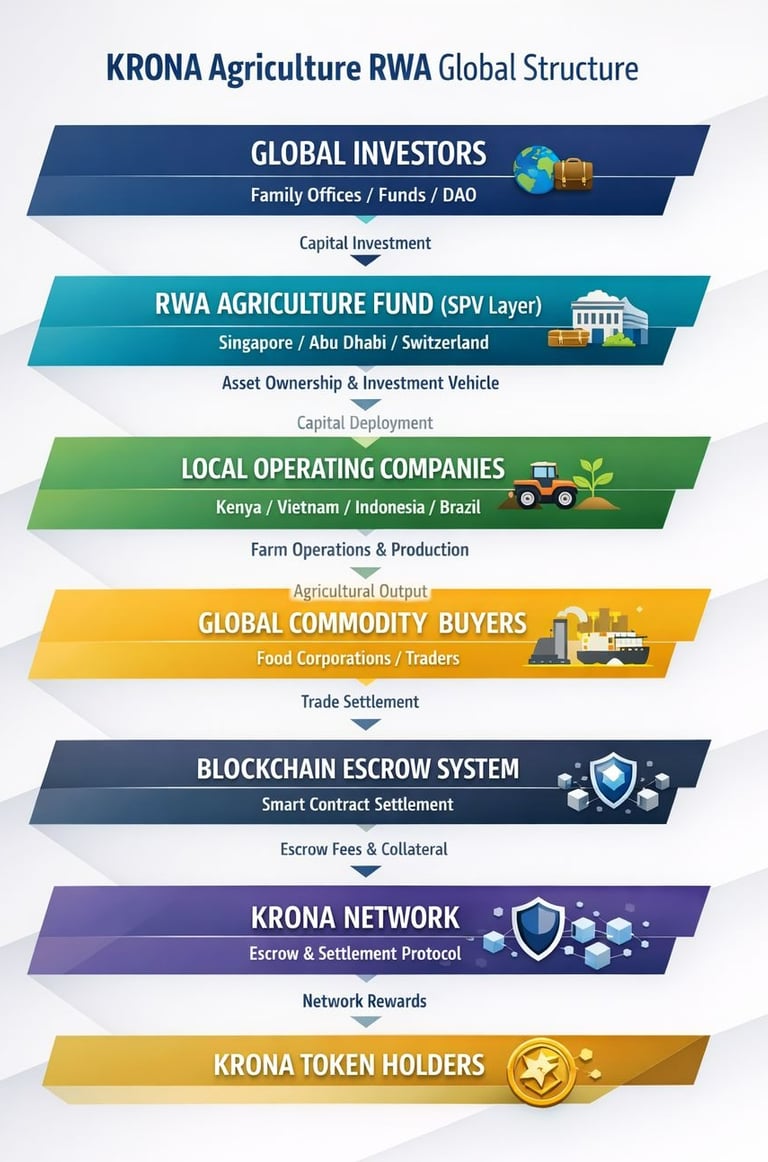
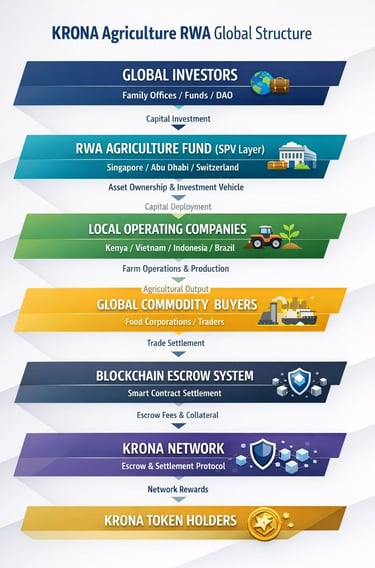
Global Structure
GLOBAL INVESTORS
(Family Offices / Investment Funds / DAO)
│
│ Capital Investment
▼
RWA AGRICULTURE FUND (SPV Layer)
Singapore / Abu Dhabi / Switzerland
Asset Ownership & Investment Vehicle
│
│ Capital Deployment
▼
LOCAL OPERATING COMPANIES
Kenya / Vietnam / Indonesia / Brazil
Farm Operations
Labor Management
Crop Production
│
│ Agricultural Output
▼
GLOBAL COMMODITY BUYERS
Food Corporations / Commodity Traders
│
│ Trade Settlement
▼
BLOCKCHAIN ESCROW SYSTEM
Smart Contract Settlement
│
│ Escrow Fees
▼
KRONA NETWORK
Escrow
Settlement
Collateral Infrastructure
│
│ Network Rewards
▼
KRONA TOKEN HOLDERS
Core Architecture
Separation of Investment and Token Utility
The KRONA ecosystem separates investment vehicles from token utility, ensuring that the token functions strictly as network infrastructure rather than a financial security.
Investment activities are conducted through regulated SPV structures, while the KRONA token powers the operational layer of the network.
Investment Layer
RWA Agriculture SPV Funds
Institutional capital allocation
Farm development financing
Protocol Layer
KRONA Network
Escrow infrastructure
Trade settlement
This design enables regulatory compatibility across major jurisdictions while maintaining scalability for global agricultural markets.
Agricultural RWA Asset Structure
KRONA focuses on enabling infrastructure for agricultural transactions rather than tokenizing physical assets.
Underlying Agricultural Assets
Farm Land Lease Agreements
Agricultural Equipment
Crop Production Contracts
Commodity Offtake Agreements
These assets remain within traditional legal frameworks and are not tokenized on-chain.
Instead, the blockchain layer manages trade settlement and escrow operations.
KRONA Token Utility
The KRONA token functions as the operational utility of the network.
Key roles include:
Escrow Collateral
Collateral required for agricultural trade settlements.
Settlement Fees
Network fees for executing escrow-based trade transactions.
Trade Guarantees
Ensuring accountability between agricultural producers and buyers.
Logistics Settlement
Supporting payment flows related to agricultural transport and delivery.
Insurance Settlement
Trigger-based payouts for insured agricultural events.
Through these functions, KRONA acts as the transaction backbone of the agricultural supply chain.
Capital Flow
The capital flow within the KRONA ecosystem follows a structured multi-layer model.
Investment
Investors allocate capital into agricultural SPV funds.
Development
SPV funds deploy capital to develop and operate farms through local operators.
Production
Farms produce agricultural commodities such as coffee, rice, soybeans, and cocoa.
Trade Settlement
Commodity buyers purchase agricultural output through escrow-based contracts.
Revenue Distribution
Escrow settlements distribute funds to operational costs, investor returns, and insurance reserves.
Network Fees
Escrow fees are paid to the KRONA network and distributed as network rewards.
Risk Management Structure
KRONA's architecture separates key risk components across different operational layers.
Investment Risk
Managed by the SPV investment structure.
Operational Risk
Handled by local farm operating partners.
Settlement Risk
Controlled through blockchain-based escrow contracts.
Market Risk
Mitigated through commodity offtake agreements.
Logistics Risk
Managed through regional agricultural supply chains.
This distributed structure ensures that risks are isolated and managed by specialized entities.
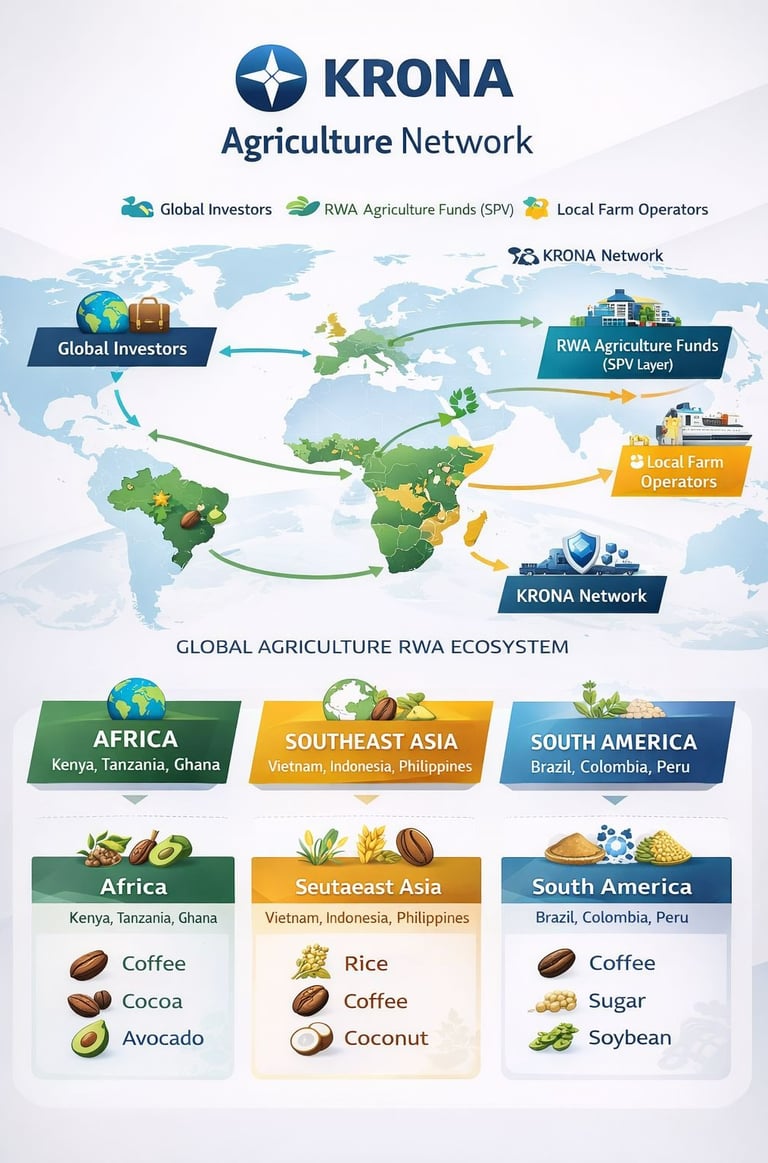
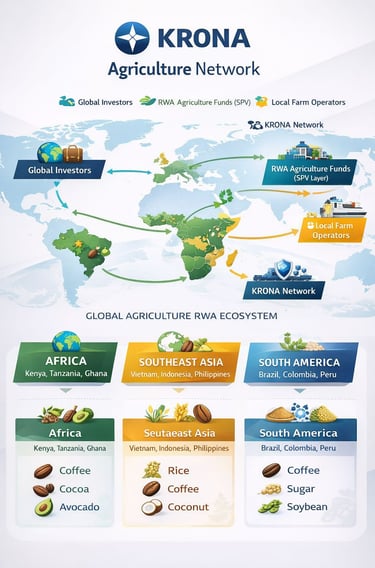
Global Agriculture Regions
KRONA focuses on agricultural regions with strong global commodity demand.
Africa
Kenya
Tanzania
Ghana
Primary Crops
Coffee
Cocoa
Avocado
Southeast Asia
Vietnam
Indonesia
Philippines
Primary Crops
Rice
Coffee
Coconut
South America
Brazil
Colombia
Peru
Primary Crops
Coffee
Sugar
Soybeans
The KRONA Vision
KRONA aims to become the global settlement infrastructure for agricultural trade.
By combining real-world agricultural production with blockchain-based escrow systems, the network enables a scalable and transparent ecosystem for global food supply chains.
KRONA
Email: info@krona.cloud
© 2025 Krona. All rights reserved.
Contact Us
KRONA Token functions as a utility token for payment, escrow, staking, and risk control, enabling automated settlement, economic accountability, and global scalability for real-world commerce.