warning: There is no guarantee of future profits, platform success, or token value appreciation.

Characteristics and Advantages of RWA Business in Cambodia
Real World Asset (RWA) businesses in Cambodia refer to models that connect physical assets such as land, agriculture, infrastructure, commodities, and real estate with blockchain or tokenized financial structures. Among Southeast Asian countries, Cambodia has structural conditions that are particularly favorable for RWA development. Below is a detailed explanation of the key characteristics and advantages of RWA projects in Cambodia.
3/31/20262 min read
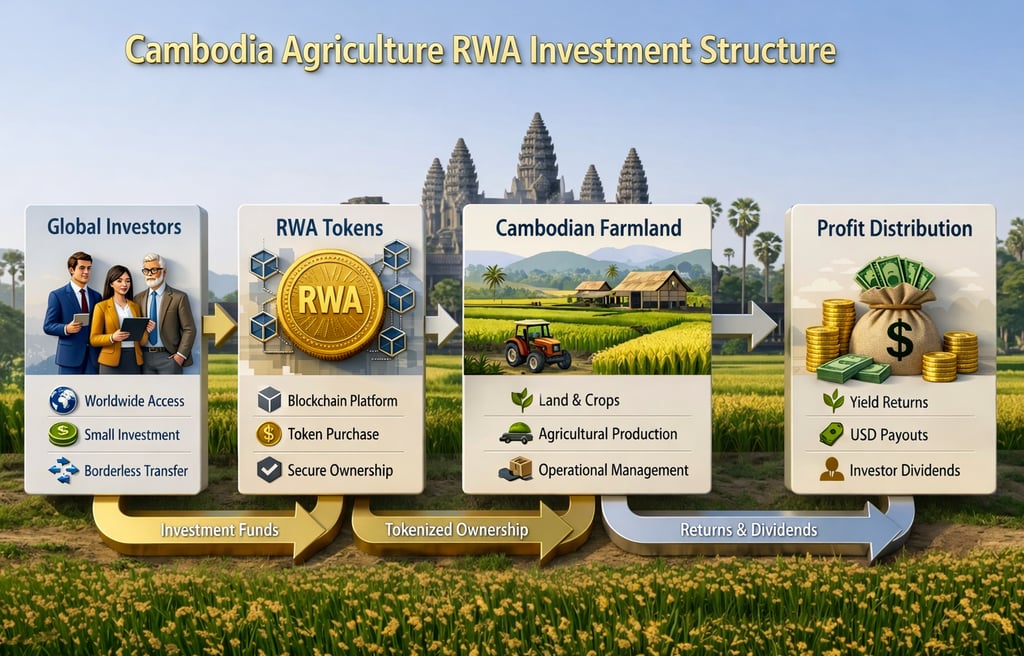
Introduction to Real World Assets in Cambodia
In recent years, the concept of Real World Assets (RWA) has gained significant traction, especially in developing economies like Cambodia. These businesses leverage the intersection of physical assets—including land, agriculture, infrastructure, commodities, and real estate—with blockchain technology and tokenized financial models. By doing so, they create opportunities for transparency, liquidity, and accessibility in the financial sector. This blog explores the unique structural conditions and advantages that make Cambodia a fertile ground for RWA development.
Favorable Structural Conditions for RWA Development
Cambodia's evolving economic landscape provides distinct structural advantages for RWA businesses. One of the critical factors is the increasing governmental support for digital transformation and financial inclusivity. The Cambodian government has actively promoted policies that encourage investment in technology-driven sectors, thus facilitating the integration of blockchain solutions. With an agricultural economy that heavily relies on physical assets, there is ample potential for tokenization of land and produce, allowing for increased investment and improved liquidity.
Moreover, Cambodia’s youthful demographic and growing tech-savvy population are more inclined to adopt innovative financial solutions. This trend aligns with the global shift towards digitization, making Cambodia a prime location for RWA ventures that aim to connect traditional asset classes with contemporary financial technologies.
The Advantages of RWA Projects in Cambodia
RWA projects in Cambodia are not only innovative but also strategically positioned to capitalize on various advantages. Firstly, the integration of blockchain technology ensures enhanced security and traceability of assets. This is particularly crucial in countries where property rights and ownership can often be murky. With smart contracts and transparent ledgers, disputes related to asset ownership or usage can be minimized.
Secondly, tokenization of assets allows for fractional ownership, making investments more accessible to a broader audience. This democratization of investment opportunities could spur local economic development by enabling smaller investors to participate in previously unattainable markets. Furthermore, the introduction of RWAs can increase foreign interest and investment in the Cambodian economy, attracting capital that can be utilized for infrastructure and community development projects.
Finally, RWA businesses have the potential to foster sustainability. By connecting agriculture and natural resources with blockchain, companies can implement environmentally sustainable practices, incentivizing responsible management of resources, which is critical for a nation like Cambodia that is confronting issues related to climate change.
Conclusion
The potential for Real World Asset businesses in Cambodia is immense, given the country's favorable structural conditions and the inherent advantages that come with blockchain integration and tokenization. As RWA projects continue to develop, they promise to transform Cambodia's economic landscape, making it a leader in the ASEAN region for innovative financial solutions. Stakeholders must continue to collaborate, ensuring that this promising movement thrives while addressing the unique challenges faced within the local context.
KRONA
Email: info@krona.cloud
© 2025 Krona. All rights reserved.
Contact Us
KRONA Token functions as a utility token for payment, escrow, staking, and risk control, enabling automated settlement, economic accountability, and global scalability for real-world commerce.